
Picture this. A customer walks into your store looking for a specific item. The shelf, however, is empty. You didn’t know your store had run out of the item because your inventory system always runs its updates overnight. Disappointed, your customer leaves and goes to another store.
You didn’t lose the customer because you didn’t have the data. You lost the customer because you couldn’t act on that data fast enough. Edge computing, however, could have prevented this scenario—and hundreds more like it happening every day in your store.
In this blog, we’re going to look at 5 examples of edge computing use in the retail industry, and the top 5 benefits that retailers can take advantage of. Never heard of edge computing before? We’ll cover that, too.
Let’s dive in!
Key Takeaways
Edge computing allows your retail store to respond to what’s happening at that exact moment. No more waiting for data to be processed elsewhere.
By keeping data processing inside your store, edge computing helps you reduce delays across everyday operations, such as inventory updates, checkout and customer interactions.
Over time, edge computing can help your organization shift from reactive to proactive store management.
What Is Edge Computing in Retail? A Quick Overview
Smart shelf sensors. Point-of-Sale (POS) terminals. IP surveillance cameras. RFID scanners. Digital signage controllers. Kiosk gateways. These are all examples of devices commonly found in retail settings. When these devices are paired with local processing capabilities, data can be analyzed and acted on in real time.
Effectively, edge computing refers to processing and analyzing data near its source rather than sending it to a centralized cloud or data center for processing. By reducing the distance data must travel, you can respond faster to events and make more timely decisions.
This enables capabilities such as real-time inventory alerts, dynamic pricing, intelligent checkout experiences, and in-store analytics.
How Is Edge Computing Used in Retail? 5 Common Use Cases
To get a better picture of what edge computing is, let’s look at five examples specific to the retail industry.
1. Smart Shelf Monitoring
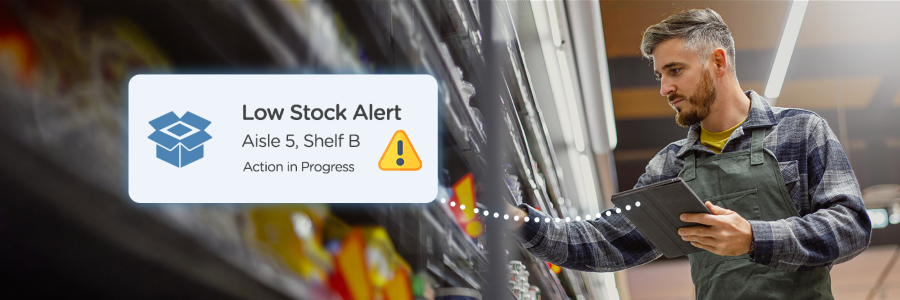
Smart shelf monitoring uses technologies such as RFID tags and weight sensors to track inventory levels in real time. When stock is running low, alerts can be sent to employees responsible for restocking the shelves. By processing this data locally—near the edge—low-stock conditions can be detected immediately, reducing response times and preventing out-of-stock situations from impacting customer experiences.
2. Intelligent Point of Sale (POS) Systems
Modern Point of Sale (POS) systems do not solely depend on internet connectivity or cloud databases to function. They maintain a localized inventory database of all products and services directly on the local network. This means that if network connectivity drops, the system still pulls the required data needed to process sales, ensuring your customers can check out smoothly and seamlessly.
3. Interactive Digital Signage & Smart Screens
Edge computing in retail can support interactive digital signage that display timely information to customers, such as product availability, personalized recommendations based on previous purchases, promotional offers, etc. By processing data near the edge, you can deliver immediate updates without relying entirely on cloud-based systems.
4. Queue & Traffic Flow Management
Edge computing allows you to analyze video feeds locally to monitor patterns and customer flow in real time. This can help identify situations such as:
When lines are growing too long
When crowds are forming in specific areas
If customers are looking for assistance
What zones might need more associates (for example, check-out lines, fitting rooms, or various counters within the store)
When predefined thresholds are met—such as long checkout lines—store associates can automatically be alerted to the issue, helping address bottlenecks and improve customer service before shoppers become frustrated and leave.
5. Smart Shopping Carts
While self-checkouts have been around for a while, smart shopping carts are becoming more mainstream. In fact, one third (33%) of global customers are currently using smart shopping carts, and 65% of global supermarkets are adopting smart cart technologies.
These smart shopping carts can:
Detect items added to the cart
Update the total price
Provide item location, product suggestions, and/or discount alerts
With edge computing, the data collected from smart shopping cart sensors can be processed almost immediately, enabling real-time item recognition, pricing updates and product recommendations. This helps you provide a more seamless shopping experience while allowing customers to complete purchases more quickly and accurately.
Top 5 Benefits of Edge Computing in Retail
Real-Time Reliability | Faster Decision-Making | Reduced Bandwidth Costs | Offline Operations | Personalized Shopping Experiences |
Ensure critical devices and systems continue operating efficiently. | Reduce delays between detection and action, as operational issues surface more quickly. | Transmit only relevant data. | Continue operating even if connectivity is lost. | Deliver real-time insights, recommendations and promotions to your customers. |
Now that you know what edge computing is and why retailers should pay attention to it, let’s examine the top 5 benefits that retailers can take advantage of:
1. Real-Time Reliability During Peak Times
When your store gets busy, having control and visibility over in-store devices can make all the difference. Edge computing helps ensure these critical devices and systems continue operating efficiently by processing data locally, thus reducing delays. This helps ensure smooth checkout and customer service during the moments that matter the most.
2. Faster Decision-Making with Minimal Delay
How much easier would life be if your store teams could see problems as they happen, whether that’s a register acting up or a critical device going offline? By processing data locally, operational issues can surface more quickly, reducing delays between detection and action. When edge computing is paired with real-time insights into device health and performance, you can address issues immediately instead of discovering them when a customer is already affected.
3. Reduced Bandwidth Costs
Processing data locally and transmitting only relevant data reduces bandwidth usage between your store and central systems. Rather than sending everything and potentially overloading your network, you can reduce bandwidth costs by focusing on sharing only the most important information, such as alerts, usage patterns or performance issues. Your store still gets the insights it needs, but bandwidth and resources aren’t wasted.
4. Offline Operations & Resilience
In-store devices must continue to work, even if your Wi-Fi or Internet service experiences an interruption. Your store doesn’t stop just because you lose connectivity. Your customers still expect to be able to check out. By ensuring critical processing occurs locally, many retail operations can continue functioning even if connectivity is lost.
5. Real-Time Personalized Shopping Experiences
Understanding what’s happening on the floor in real time helps your store deliver more relevant and timely customer experiences. Edge computing enables operational insights, recommendations and promotions to be delivered more quickly, helping employees respond faster and creating more personalized shopping experiences for customers.
Conclusion
You’re under constant pressure to operate smarter, move faster and deliver more innovative approaches to shopping that provide better in-store experiences for your customers. As we’ve explored throughout this blog, edge computing provides a practical way to meet those demands.
By processing your critical data locally, you can see what’s happening on the floor and respond more quickly to issues that arise. Whether it’s restocking shelves in real time, managing checkout lines so that customers aren’t waiting, or delivering a more personal touch to customer interactions, edge computing helps keep your operations running smoothly and your customers satisfied.
If your retail operations rely on a growing ecosystem of connected devices, from mobile POS systems and kiosks to smart sensors and digital signage, learn how SOTI helps you manage and support these critical devices at scale.
Connect with us today and let’s get started!